


Generative Adversarial Networks (GANs): The AI Engine Behind Synthetic Realism - AI Wiki

Generative Adversarial Networks, or GANs, represent one of the most fascinating and impactful architectures in modern deep learning. Celebrated for their ability to generate astonishingly realistic, high-quality synthetic data, GANs have catalyzed breakthroughs across fields from digital art to scientific research. This article delves into what GANs are, how their unique adversarial training works, the distinct advantages they offer over other neural network models, and their diverse, transformative applications.
What is a GAN?
A Generative Adversarial Network (GAN) is a machine learning framework where two neural networks are pitted against each other in a continuous, minimax game. This setup involves:
- The Generator: A neural network that creates synthetic data samples (e.g., images, audio) from random noise. Its goal is to produce outputs indistinguishable from real data.
- The Discriminator: A rival neural network that acts as a critic. It receives both real data samples and the Generator's fakes, attempting to correctly classify them as "real" or "generated."
This adversarial dynamic—a digital arms race between creation and critique—drives both networks to improve iteratively until the Generator's outputs achieve remarkable realism.
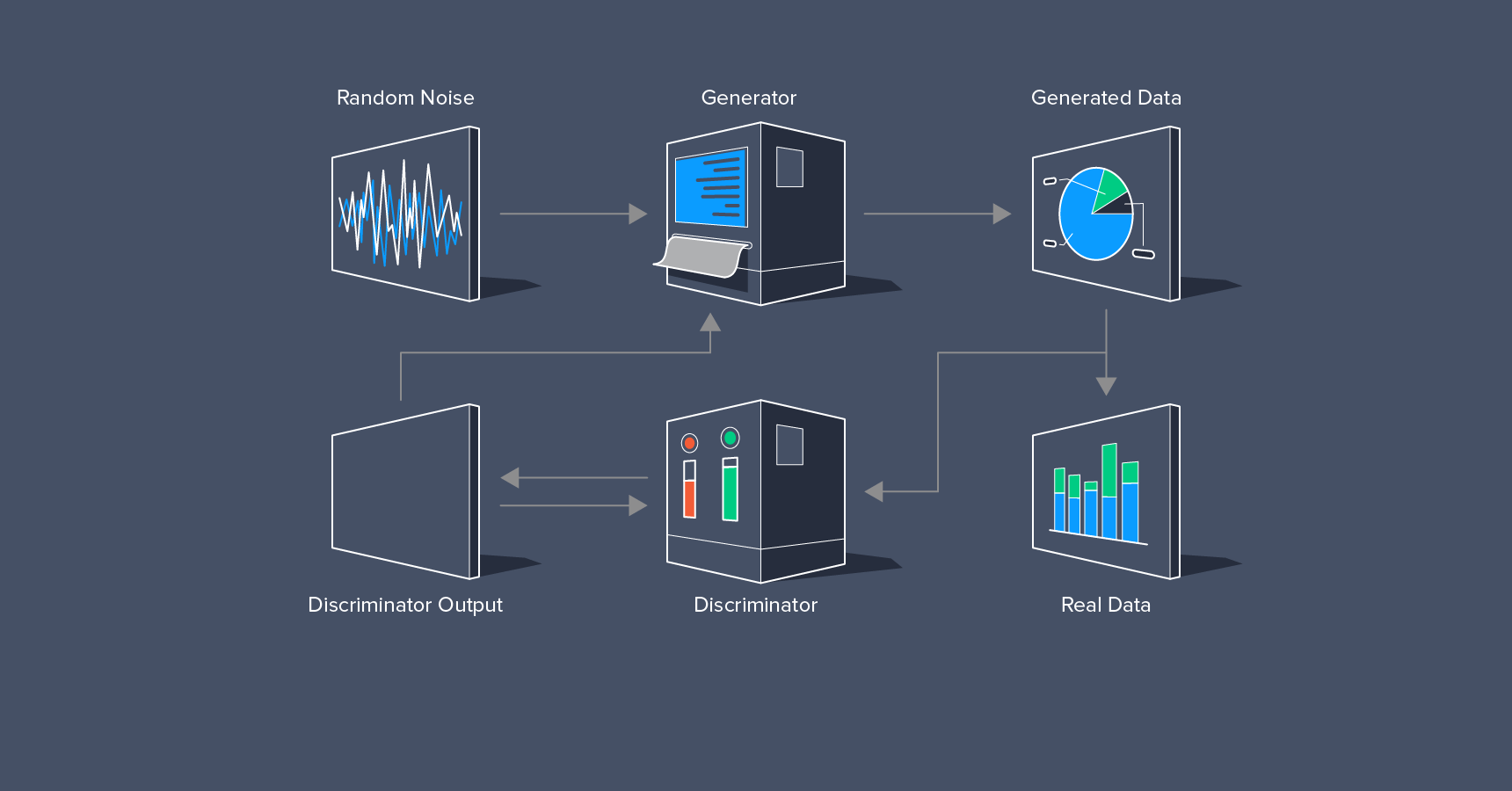
GAN Architecture and How It Works
The training process of a GAN is a carefully orchestrated duel:
- Phase 1: Train the Discriminator. A batch of real data is sampled from the training set, and a batch of fake data is created by the Generator. The Discriminator is trained on this combined set, updating its weights to become better at telling real from fake.
- Phase 2: Train the Generator. New random noise is fed into the Generator to create another batch of fakes. This time, however, the Generator's weights are updated based on how successfully it fooled the Discriminator. The key is using the Discriminator's feedback (its gradients) sent backward through the network—a process known as backpropagation—to guide the Generator toward producing more convincing data.
- Iteration. These two phases repeat in a loop. The Discriminator strives to become a perfect critic, while the Generator learns to mimic the true data distribution with increasing precision. Ideally, they reach a Nash equilibrium where the Discriminator can do no better than random guessing (50/50), meaning the Generator's output is perfectly realistic.
Advantages of GANs Over Other Neural Network Models
GANs provide unique benefits that make them superior for specific generative tasks:
- Unsupervised Learning Power: GANs learn the underlying patterns and distributions of data without needing explicit labels, making them ideal where labeled datasets are scarce or expensive.
- Exceptional Output Quality: When trained successfully, GANs can generate data of exceptionally high fidelity, often visually or semantically matching real-world samples.
- Architectural Flexibility: The core GAN framework can be integrated with other neural network types like Convolutional Neural Networks (CNNs for images) or Recurrent Neural Networks (RNNs for sequences), enabling the generation of diverse data forms.
- Potent Data Augmentation: GANs can create high-quality synthetic training data, helping to reduce overfitting and significantly improve the performance of other models trained on small datasets.
Key Applications and Use Cases of GANs
The versatility of GANs has led to pioneering applications across numerous domains:
- Image Synthesis & Generation: Creating photorealistic human faces (e.g., StyleGAN), artwork, fictional characters, or entirely new product and landscape images.
- Style Transfer: Modifying the artistic style of an image (e.g., making a photo look like a Van Gogh painting) using models like CycleGAN.
- Data Augmentation for AI Training: Generating additional, varied training samples for computer vision models in healthcare (e.g., synthetic medical imagery) or robotics.
- Text-to-Image Generation: Translating textual descriptions into detailed corresponding images, aiding in design, advertising, and creative storytelling.
- Image Enhancement & Inpainting: Performing super-resolution to upscale low-quality images and inpainting to realistically fill in missing or corrupted parts of an image (useful in photo restoration and editing).
- Drug Discovery & Material Science: Generating novel molecular structures with desired properties, accelerating the screening process for new pharmaceuticals and materials.
- Anomaly Detection: By learning the distribution of "normal" data, GANs can effectively identify outliers or anomalies, useful in fraud detection, network security, and industrial defect inspection.
In summary, Generative Adversarial Networks have fundamentally expanded the horizons of what artificial intelligence can create. By mastering the distribution of real-world data through adversarial learning, they provide a powerful, flexible tool for generation, enhancement, and discovery, continuing to drive innovation at the forefront of AI.
Related AI column
























0 Comment