






GPTZero
GPTZero is an AI-powered content detection and authenticity platform designed to identify whether text was generated by a large language model (LLM) such as ChatGPT, GPT-4, Gemini, Claude, or LLaMA. Widely used by educators, publishers, and professionals, GPTZero helps verify human writing, reduce misuse of AI content, and maintain trust in academic and professional contexts.
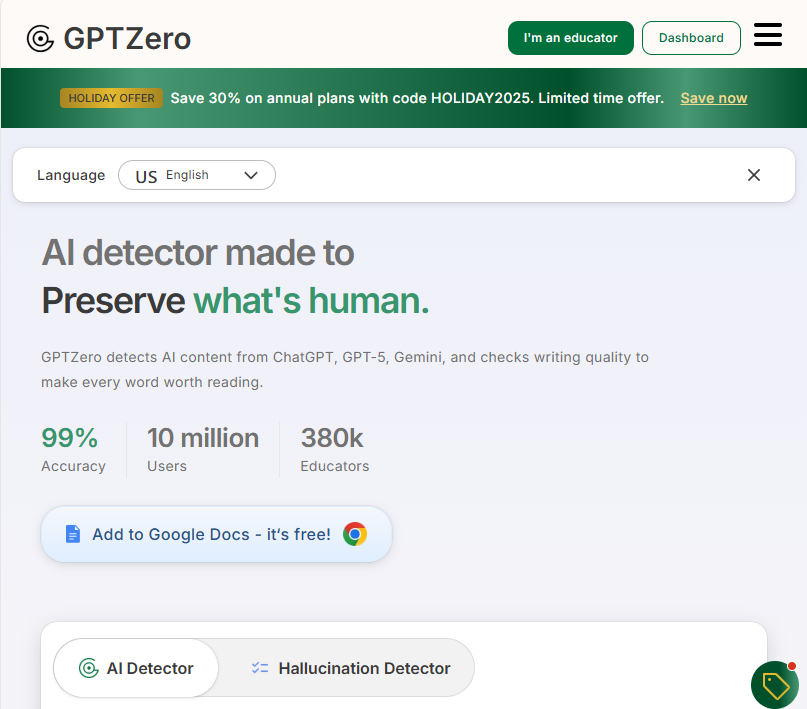
What Is GPTZero?
GPTZero is a specialized AI content detection software built to analyze text and estimate the likelihood that it was generated by an AI model rather than written by a human. Launched in early 2023, GPTZero has grown into one of the most widely used tools for checking writing authenticity, with millions of users and adoption in educational institutions, businesses, and publishing workflows.
Unlike simple keyword-based checkers, GPTZero uses machine learning models trained to recognize linguistic patterns and stylistic features that differentiate AI-generated text from human writing.
Core Features & Capabilities
GPTZero offers several powerful tools to analyze and interpret text:
- AI Text Detection: Classifies text at the document and sentence level to determine the probability of AI generation.
- Multi-Model Detection: Detects outputs from major AI models including ChatGPT, GPT-4, GPT-5, Gemini, Claude, and LLaMA derivatives.
- Sentence-Level Highlights: Provides color-coded feedback showing exactly which parts of a document are likely AI-generated.
- Plagiarism & Authorship Tools: In some plans, GPTZero can also perform plagiarism checks and offer writing pattern analysis for deeper authenticity verification.
- Integrations: Browser extensions and integrations allow detection directly in tools like Google Docs or via API for developers and enterprises.
These capabilities make GPTZero more than a basic checker — it’s a comprehensive authenticity and content integrity platform for text verification.
Typical Use Cases
GPTZero’s detection technology supports a variety of practical scenarios:
- Education & Academic Integrity: Teachers and institutions use GPTZero to evaluate student essays and research papers for potential AI-generated writing.
- Publishing & Journalism: Editors and content teams check articles and submissions to ensure originality before publication.
- Corporate & HR Review: Businesses use AI detection when evaluating professional reports, proposals, or written assessments.
- Content Quality Assurance: Writers and creators check drafts to better understand how AI tools may have influenced the text.
GPTZero’s detailed reports and probability scores help users make informed decisions about the authenticity and authorship of text.
How It Works
GPTZero analyzes text using proprietary machine learning models that evaluate patterns such as perplexity (how predictable the writing is), burstiness (variation in sentence lengths and styles), and other statistical indicators that differ between AI-generated and human writing.
The tool continually updates its detection models to remain effective against newer AI models and paraphrasing methods. Its technology includes features designed to handle mixed content (human + AI) and reduce false positives, particularly for non-native English writing.
Benefits & Limitations
Benefits:
- Highly accurate detection: Benchmarks suggest detection accuracy over 95% for many common AI text scenarios.
- Granular insights: Sentence-level analysis and confidence scores give transparent feedback.
- Broad model coverage: Detects text from many popular large language models.
Limitations:
- No AI detector is perfect — results should be used as indicative guidance, not absolute proof of authorship.
- Accuracy may vary with very short text and highly stylized writing.
Plans & Pricing
GPTZero offers a range of plans: a free tier with basic detection tools and limited scans, and paid plans that unlock unlimited detection, advanced analytics, plagiarism checks, and integrations. Some pricing structures include monthly subscriptions as well as lifetime access options.
Paid plans typically provide more extensive usage limits and deeper analysis features, making them suitable for educators, professionals, and organizations with frequent content verification needs.
Related AI Tools





0 Comment