






Meta LLaMA 3
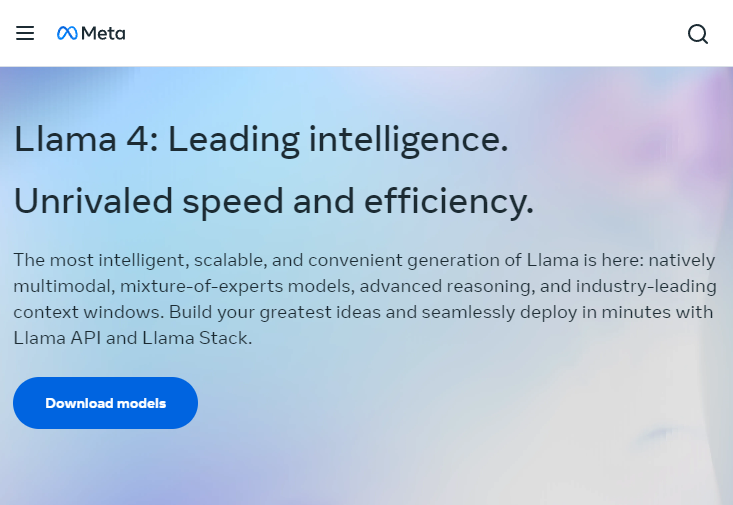
Meta LLaMA 3 is the latest generation of large language models (LLMs) developed by Meta (formerly Facebook) designed for text understanding, generation, reasoning, summarization, translation, and code tasks. Released in April 2024, it represents a major upgrade over prior LLaMA models in training scale, performance, and versatility and is offered under a broadly permissive “open-weights” regime that supports wide research and commercial use.
Introduction to Meta LLaMA 3
Meta LLaMA 3 is the third major version in the LLaMA series of large language models, aimed at delivering state-of-the-art AI language capabilities while maintaining accessibility for developers and researchers. It was officially introduced by Meta on April 18, 2024, and is distinguished by significant training scale increases and architecture improvements that boost its reasoning and text generation power.
Core Capabilities
- Natural Language Generation & Understanding: Optimized for tasks such as conversation, summarization, translation, paraphrasing, and question-answering with high fluency and coherence.
- Instruction-Tuned Models: Versions of LLaMA 3 are fine-tuned to follow user instructions, making them more suitable for chat-style and assistant-like applications.
- Code and Reasoning: Improved ability to generate and understand programming code and solve reasoning tasks compared with earlier open models.
- Multilingual Support: Trained on large, diverse datasets covering many languages, enabling better performance across non-English languages.
- Expanded Context: Capable of processing longer sequences of text (up to thousands of tokens), allowing complex, multi-step prompts and tasks.
Model Variants and Scale
LLaMA 3 is available in different parameter sizes to meet various requirements:
- 8 B (8 billion) parameters — lighter, suitable for smaller-scale deployments.
- 70 B (70 billion) parameters — larger and more capable for demanding use cases.
- Meta and the community have also discussed larger versions (hundreds of billions of parameters) and subsequent iterations (e.g., LLaMA 3-series updates) that push capabilities further.
Training and Technology
LLaMA 3 was trained on an exceptionally large corpus — over 15 trillion tokens of publicly available text and code — which helps it deliver stronger generalization and reasoning compared with predecessors. It uses enhancements like grouped query attention (GQA) to improve efficiency at inference time.
Use Cases and Integration
- Custom AI Assistants: Build chatbots and conversational interfaces with context-aware responses.
- Content Generation: Generate drafts, summaries, and creative text across domains.
- Research & Development: Experiment with open weights for new AI workflows and applications.
- Enterprise Software: Integrate advanced language understanding into products such as search, analytics, and automation tools.
Accessibility and Licensing
While widely described as “open” and available for download and use in research and production applications, LLaMA 3 models are sometimes characterized as “open weights” rather than fully open-source according to strict definitions, due to specific licensing terms that govern certain uses.
Related AI Tools




0 Comment