






ReadPo
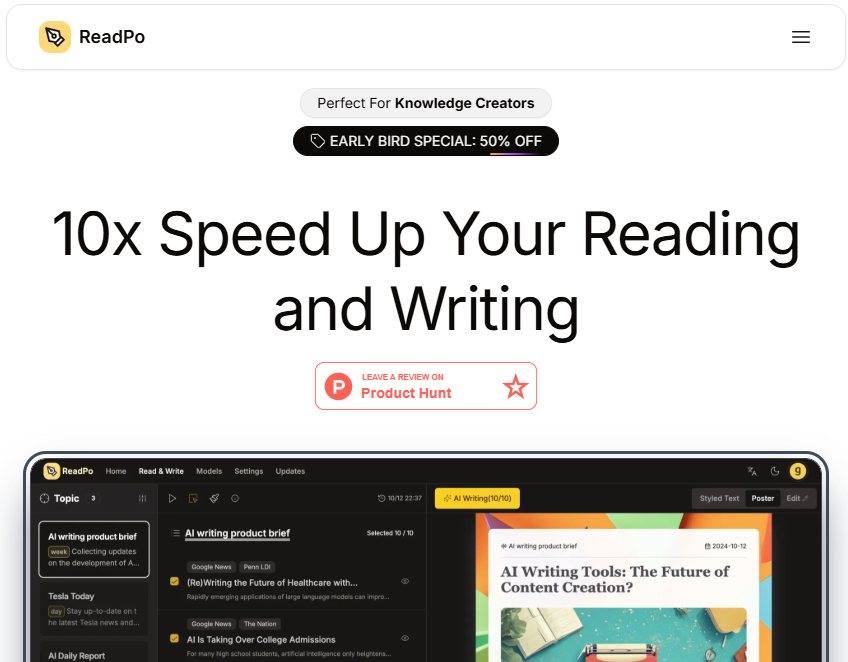
ReadPo is an AI-powered reading and writing assistant designed to help knowledge creators — such as writers, researchers, bloggers, and professionals — process large volumes of information quickly and efficiently. It aggregates content from diverse sources, summarizes key points with AI assistance, and helps users generate new written outputs like articles, newsletters, or posters from curated data. ReadPo aims to reduce information overload and accelerate the content creation workflow with intelligent summarization, topic management, and content generation capabilities.
What Is ReadPo?
ReadPo is an AI reading and writing productivity platform that combines content aggregation, summarization, topic organization, and AI-assisted writing into a unified toolset. It is designed to help users collect and process information from multiple sources and transform it into high-quality written outputs more efficiently than traditional manual methods.
Core Features
Content Aggregation & Sourcing
ReadPo connects to multiple sources such as Google News, Twitter (X), and RSS feeds to collect relevant content on a given topic. Users can manage multiple topics of interest and gather information automatically to reduce manual searching.
AI-Based Summarization
The platform uses AI to quickly read and summarize articles collected from different sources, highlighting key points and insights to help users understand and retain information more effectively.
Writing Assistance & Generation
After aggregating and summarizing content, ReadPo assists in generating new written work such as blog posts, newsletters, digests, or posters. It supports custom prompts and RAG (retrieval-augmented generation) workflows for tailored output.
Topic Management
Users can create multiple topics or projects to organize readings and outputs by subject, enabling structured workflows for research or long-form content creation.
Output Formats
ReadPo supports generating diverse formats including text articles, visual posters, and structured digests, making it useful for content marketing, newsletters, social media, and personal knowledge management.
How It Works
- Create Topics: Start by defining topics you want to research or write about.
- Add Content Sources: Connect sources like Google News, X (Twitter), and RSS feeds to automatically gather related content.
- AI Summarization: Let ReadPo AI score, sort, and summarize collected articles to surface key insights.
- Generate Outputs: Use built-in AI writing tools to draft emails, articles, newsletters, or posters based on curated information.
- Export and Publish: Finalize the generated content and export or publish as needed.
Pricing
ReadPo adopts a freemium pricing model with tiered plans based on credits and feature limits. Available pricing information indicates:
- Free Plan ($0/month): Limited credits, topic creation allowance, summarization, writing credits, and basic source access such as Google News, X (Twitter), and RSS.
- Starter Plan (approx. $8–$10/month): Increased credits and higher topic allowances, more article fetch and generation capacity, all poster templates, and priority support.
- Pro Plan (approx. $24–$30/month): Larger monthly credits, extended capacity for article fetching and content outputs, and advanced features like agent modes (some features may be “coming soon”).
Note: Some early bird discounts (e.g., 50% off) have been offered on launch, but actual pricing and availability of discounts may vary.
Who It’s For
ReadPo is particularly beneficial for:
- Content Creators & Writers: Bloggers, newsletter authors, and marketers who need to generate large volumes of written material.
- Researchers & Analysts: Professionals who work with large datasets of articles and need quick summarization and insight extraction.
- Students & Educators: Users processing research or preparing topic briefs across multiple information streams.
- Knowledge Workers: Anyone facing information overload who needs a systematic way to read, summarize, and write faster.
Benefits
- Accelerates the reading and writing process by automating aggregation and summarization.
- Reduces manual workload and helps maintain structured workflows.
- Generates multi-format outputs (text articles, posters) from curated content.
- Helps knowledge professionals focus on insights rather than information collection.
Related AI Tools





0 Comment